
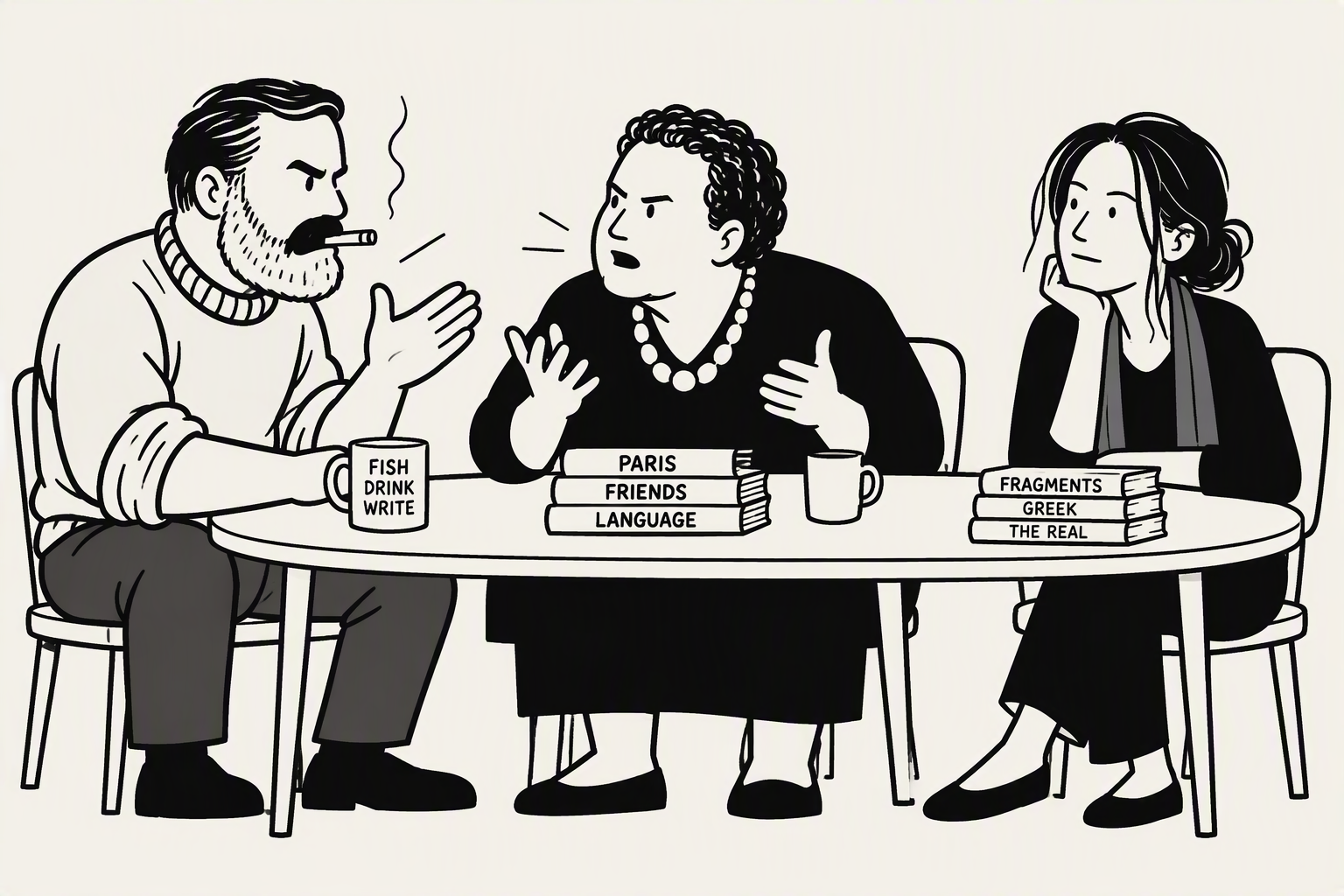
My first thought when she won the Nobel Prize for Literature was about that essay she wrote on the female voice — which I think is still THE master class on how to use Greek Mythology in modern writing.

At one point she flashes to Hemmingway’s overheard conversation while waiting and drinking for Stein. A moment in Moveable Feast that I think everyone remembers, but Carson’s read in that essay is very different. It is not about the content or the conflict of the conversation — the disrespect to a giant, etc. It is about Hemmingways horror at the Lesbian intamacy (I think — this is all from memory). I always thought that was a weird read. I think Hemmingway is seen very differently to different generations & I have never thought of him as particularly homophobic (he played “dress up”, right).
Because people asked — here is the quote I was reminded of:
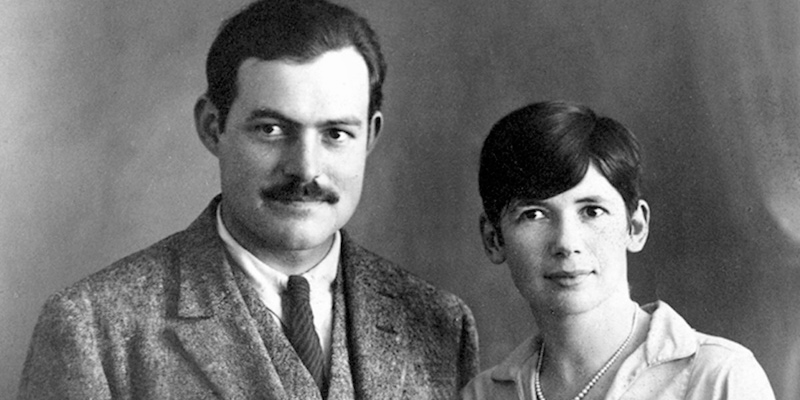
One of the literary patriarchs who feared Gertrude Stein most was Ernest Hemingway. And it is interesting to hear him tell the story of how he came to end his friendship with Gertrude Stein because he could not tolerate the sound of her voice. The story takes place in Paris. Hemingway tells it from the point of view of a disenchanted expatriate just realizing that he cannot, after all, make a life for himself amid the alien culture where he is stranded. On a spring day in 1924 Hemingway comes to call on Gertrude Stein and is admitted by the maid.
The maidservant opened the door before I rang and told me to come in and wait. Miss Stein would be down at any moment. It was before noon but the maidservant poured me a glass of eau-de-vie, put it in my hand and winked happily. The colorless liquid felt good on my tongue and it was still in my mouth when I heard someone speaking to Miss Stein as I had never heard one person speak to another; never, anywhere, ever. Then Miss Stein’s voice came pleading and begging, saying, “Don’t, pussy. Don’t. Don’t, please don’t. Please don’t, pussy.”
I swallowed the drink and put the glass down on the table and started for the door. The maidservant shook her finger at me and whispered, “Don’t go. She’ll be right down.”
“I have to go,” I said and tried not to hear any more as I left but it was still going on and the only way I could not hear it was to be gone. It was bad to hear and the answers were worse. . . .
That was the way it finished for me, stupidly enough. . . . She got to look like a Roman emperor and that was fine if you liked your women to look like Roman emperors. . . . In the end everyone, or not quite everyone, made friends again in order not to be stuffy or righteous. But I could never make friends again truly, neither in my heart nor in my head. When you cannot make friends any more in your head it is the worst. But it was more complicated than that.¹⁷
Indeed it is more complicated than that. As we shall see if we keep Ernest Hemingway and Gertrude Stein in mind while we consider another vignette about a man confronting the female voice.
The quote is from A Moveable Feast which I feel the need to remind readers was in fact a very sophisticated work of fiction addressing incredibly complicated notions of friendship — and as such this story is very relevant to the over all themes in that brilliant book.


Leave a Reply